

Selling loose bricks in bulk means turning a pile of unsorted LEGO® into cash. Bulk loose bricks typically sell for $1 to $10 per pound depending on condition, how much sorting you've done, and whether minifigures are included. That's a wide range, and where you land depends almost entirely on the choices you make before you list a single lot — or whether you skip the listing process altogether.
This guide walks through every factor that moves the needle: what determines your price, how the selling channels compare, how to prep a lot, and the mistakes that quietly cost sellers money. If your goal is the most cash with the least hassle, we'll be straight with you about the fastest path, too.
What Determines How Much You Get?
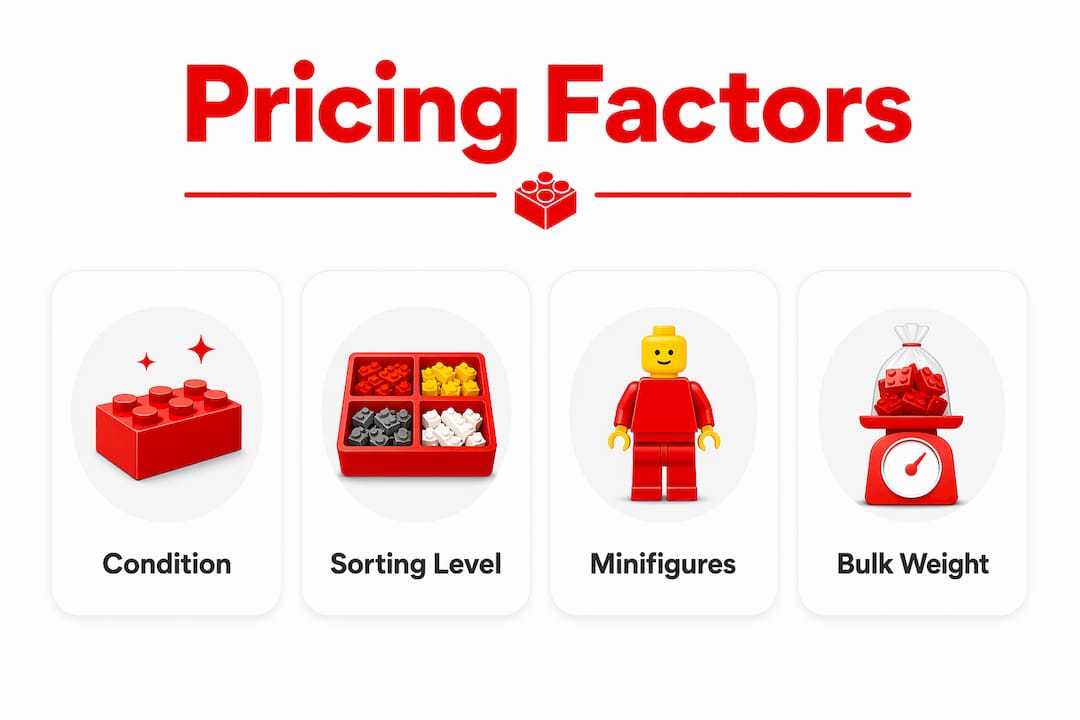
The price per pound you earn comes down to four things: condition, sorting level, minifigure count, and total weight. Understanding each helps you decide how much prep is actually worth your time.
Condition is the single biggest driver. Clean, intact bricks with no cracks, discoloration, or off-brand pieces mixed in earn the top of the range. Dirty, broken, or mixed-brand lots sit at the bottom, because buyers who resell parts need bricks they can photograph and ship without extra cleaning.
Sorting level matters, but exhaustive sorting by part number is rarely worth it. The best value-per-minute comes from quickly separating minifigures and specialty parts — not from organizing every brick by color.

Minifigures are the most underappreciated value factor in any lot. Pulling them out can dramatically increase your total payout — they sell easily on their own and carry far more value per ounce than standard bricks. Leaving a rare minifigure in a $3-per-pound bin is like tucking a $20 bill into a garage-sale box.
Weight affects buyer interest in a practical way. Lots under five pounds feel too small for bulk buyers and too big for casual collectors. For online bulk sales, the sweet spot sits between 5 and 20 pounds.
Which Selling Channel Is Right for You?
Matching your lot to the right channel is the most important decision you'll make. Large mixed lots and sorted specialty parts belong in completely different places — and some sellers are better off skipping the marketplace grind entirely.
Local marketplaces (Facebook Marketplace, local buy-sell groups) suit lots over 20 pounds, because local pickup eliminates shipping. Mailing a 25-pound box can cost $30–$50, which wrecks your margin on a low-price-per-pound lot. The tradeoff: you're meeting strangers, fielding lowballs, and coordinating pickups.
Online auction and resale sites work for mixed lots in the 5–20 pound range, where buyers expect variety. You'll need to factor shipping into your price before listing, not after a buyer commits.
Specialized brick marketplaces attract buyers who pay more per pound — but only for sorted, identified, clean pieces with accurate descriptions. If your lot is still fully mixed, you'll get low offers and slow sales here.
Buyback services offer the fastest transaction with the least effort: box it, ship it, get paid by weight. You trade a bit of per-pound upside for skipping all the sorting, listing, photographing, messaging, and shipping. For most people clearing out a closet — not running a resale business — that trade is well worth it.
How to Prep a Lot for the Highest Price
If you do go the marketplace route, preparation is where most sellers leave money on the table. A few focused steps move a lot from the bottom of the price range toward the top:
- 1Pull out minifigures and accessories first — set them aside to sell separately. Biggest impact on total payout.
- 2Remove non-LEGO pieces — Mega Bloks, Duplo, and off-brand bricks lower buyer confidence and your price.
- 3Do a quick specialty sort — pull Technic beams, large baseplates, motors, and electronics to sell on their own.
- 4Clean if needed — a warm-water rinse and air dry; never a dishwasher, which warps ABS plastic.
- 5Weigh accurately — state the weight in pounds in your title and description.
- 6Take clear photos — spread bricks on a flat, well-lit surface; honest condition notes reduce disputes.
- 7Pack before you list — know your box weight and size so you can quote shipping the moment a buyer asks.
Common Mistakes to Avoid
- Misrepresenting condition — calling a dirty or broken lot "good" generates disputes, returns, and bad feedback.
- Leaving minifigures in bulk lots — the most expensive mistake sellers make.
- Ignoring shipping costs — a $40 lot that costs $35 to ship won't sell. Calculate shipping before pricing.
- Listing on the wrong platform — heavy mixed lots move locally; sorted parts sell on specialized sites.
- Overpricing and waiting — bulk buyers are price-sensitive; list at or slightly below market to move fast.
- Slow replies — buyers who wait 48 hours for an answer move on.
“Sort strategically, not exhaustively. Twenty minutes pulling minifigures usually earns as much as a whole weekend sorting by color.”
— Samuel
The conventional advice on bulk LEGO almost always focuses on sorting: sort more, earn more. That's true up to a point, but it misses the bigger one. We've watched sellers spend entire weekends organizing bricks by color and part number, only to net roughly the same per pound as someone who spent twenty minutes pulling minifigures and specialty parts. For standard bricks, the math rarely justifies full sorting.
Our honest recommendation: if you have a large collection to move and you want cash without the hassle of sorting, listing, and shipping, a buyback service is the right call. If you want to squeeze out every last dollar and you genuinely enjoy the process, pull the minifigures, clean the bricks, and list locally for heavy lots. Both are valid — it just depends on what your time is worth.
The Fastest Path: Sell Bricks Online
If sorting, listing, and shipping feel like more work than you want to take on, Sell Bricks Online is the straightforward path to cash for loose bricks. Box them up, ship them free, and get paid by weight within five business days — no sorting required, no listings to manage, no shipping costs out of pocket.
If you have a bin, a box, or a closet full of loose bricks, this is the fastest way to turn them into real money — built for parents and everyday people, not just hobbyists running a resale operation.
New to selling LEGO? Our complete guide walks through valuing your bricks, where to sell, and safety tips.
Frequently Asked Questions
How much do loose LEGO bricks sell for per pound? Loose bricks sell for $1–$10 per pound — clean, sorted collections at the top, dirty or mixed-brand lots at the bottom.
What's the best way to sell mixed bricks in bulk? For large mixed lots over 20 pounds, local platforms avoid shipping costs that eat your margin. For zero hassle at any size, a buyback service is fastest.
Should I sort my bricks before selling? Full sorting by part number is rarely worth the time. Pulling minifigures and specialty parts takes about 20 minutes and gives the biggest value increase for the least effort — and if you sell to a buyback service, you don't sort at all.
How do I ship a heavy bulk lot? USPS Priority Mail handles lots up to 70 lbs; heavier shipments need UPS Ground or splitting into smaller boxes. (With Sell Bricks Online, shipping is prepaid and free.)
Why are loose bricks harder to sell than complete sets? Loose bricks lack the built-in demand named sets carry, and buyers can't verify completeness. Clear photos, accurate weights, and honest descriptions reduce that uncertainty — or you skip it entirely by selling to a service that pays by weight.